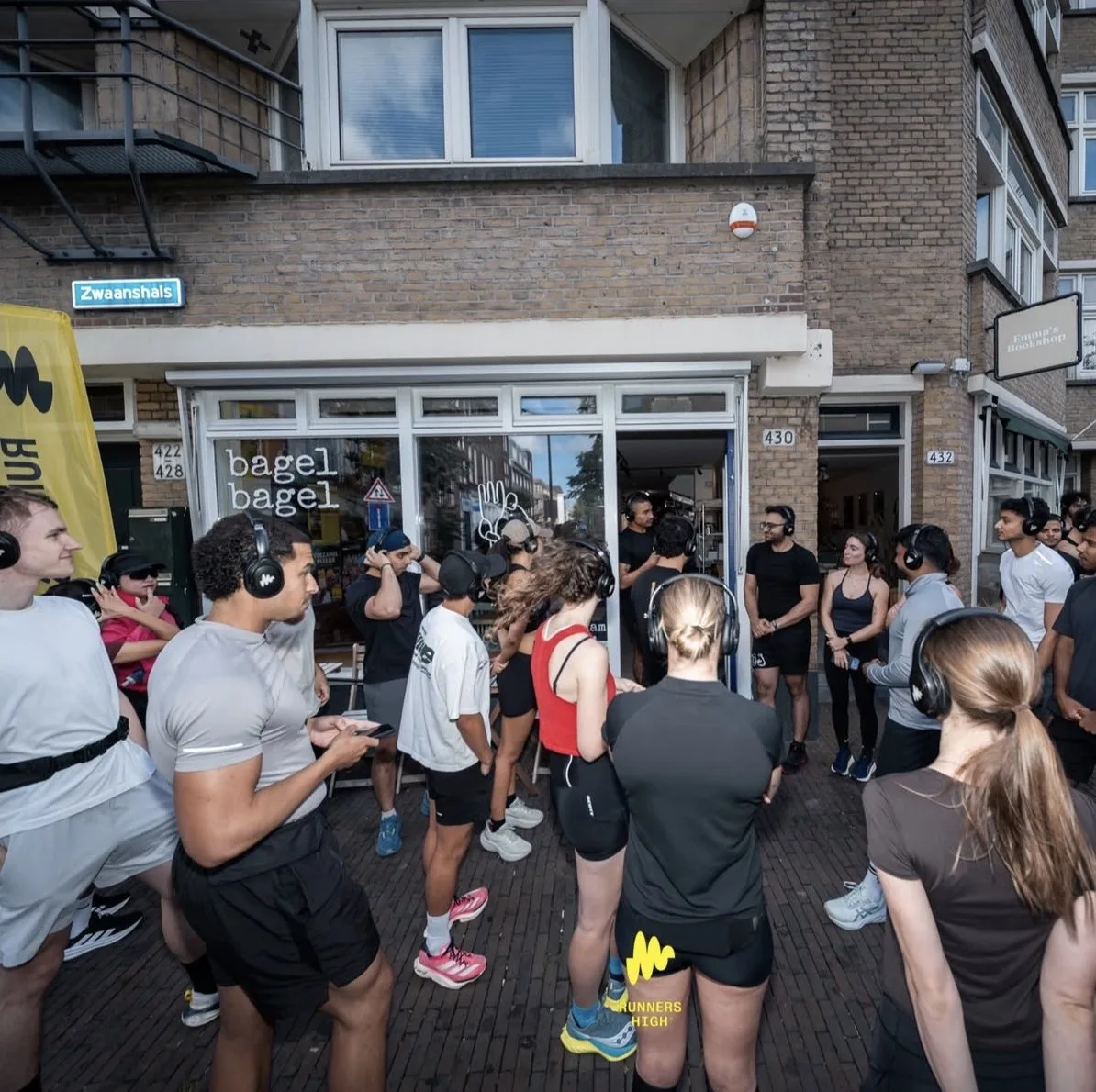
It's 9am on a Sunday morning and I have voluntarily left my bed to run 5km with approximately 30 strangers. I'm not entirely sure what this says about me, but looking around, I'm clearly not the only one. People are arriving alone, in pairs and in small groups. Some already know each other, others clearly don't. There is music, conversation and the slightly chaotic energy that comes with trying to get a group of people moving in the same direction on a Sunday morning. Eventually, we start running.
Roffa Runs began in 2024 with a simple mission: to find community and move together. Emilee Böttger started it with a former fellow organiser and runs it today. What started as a few people running around Kralingse Plas on Sunday mornings has grown into a WhatsApp community of more than 1,000 people, with around 30 runners consistently showing up each week. Despite the growth and collaborations with brands like New Balance, the mission has remained pretty simple: come as you are, meet a friend or make one.
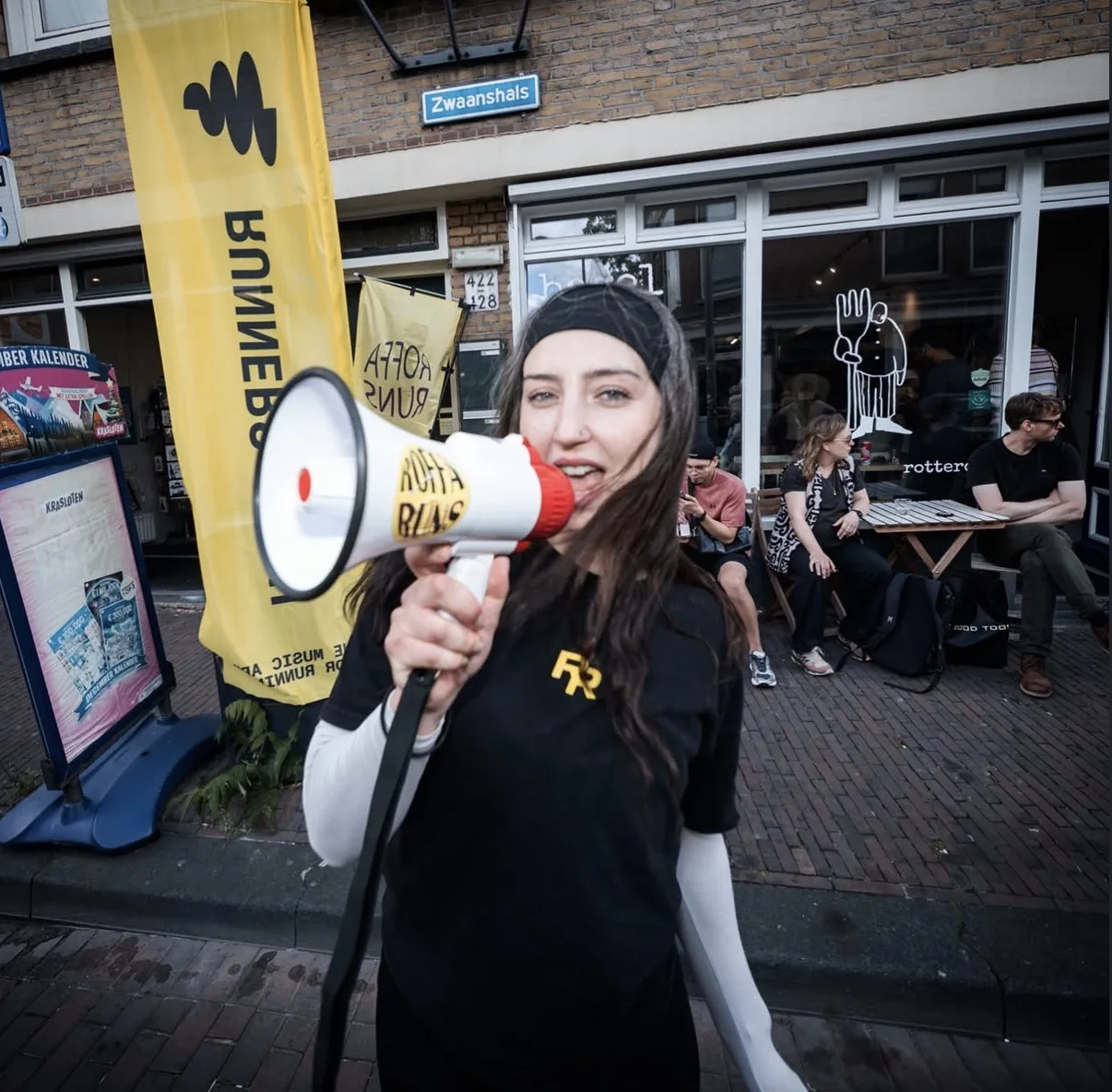
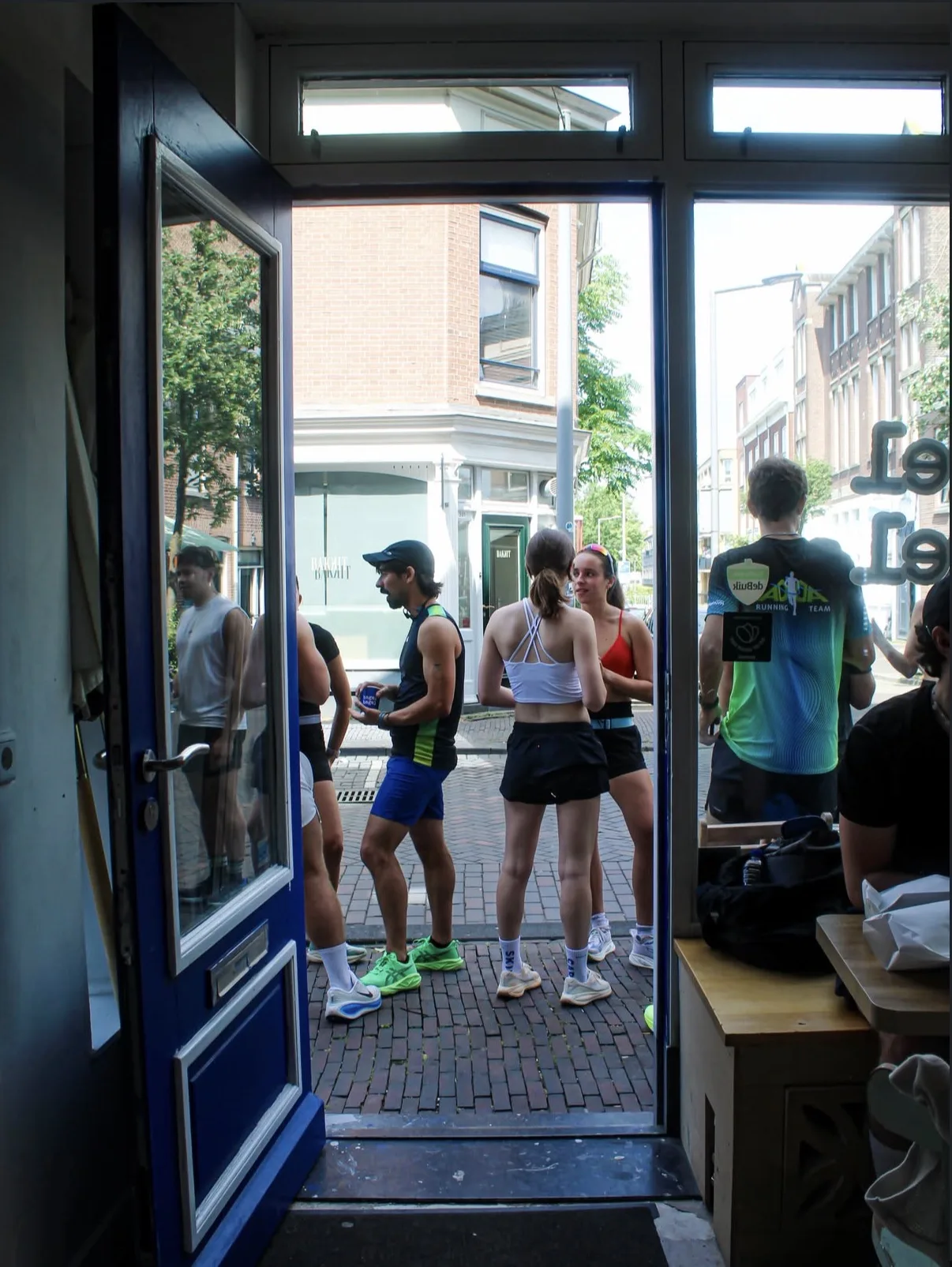
I've been lucky enough to go to a few of the runs myself, and there is something about the energy that makes the whole thing work. The pace is fun, nobody seems too concerned about how fast anyone else is running, and you don't have to know anyone before you arrive. More importantly, the run isn't really where it ends. Everyone eventually makes their way back to bagel bagel. You've just spent the last hour running alongside people you might not have known when you arrived, and now you're standing around with them, getting coffee, eating a bagel and figuring out who you're going to talk to next.
bagel bagel began in 2024, run by Daniel Tajik and his team, with a simple idea at its heart: bringing proper New York style bagels to Rotterdam while creating a place where people want to return to. The beginnings were humble. Bagels were made, assembled and sold from university apartments through Uber Eats. Since then, what started in a student apartment has grown into a storefront on Zwaanshals, selling more than 200 bagels a day, offering catering and bringing together a growing team. But on a Sunday morning, it becomes something slightly different. It becomes the place where the run finishes, where people linger for a little longer than they probably need to, where conversations continue and where someone who arrived alone can end up sitting next to someone they've just met.
And I know this because I was once that person. The first time I went to one of the runs, I had just cancelled my flights back to South Africa. I knew my brother and, thanks to Strava, had seen that there was a social 5k happening that Sunday. He thought it would be a good way for me to meet people and explore Rotterdam. I was nervous, and I was also wearing the only pair of trainers I had brought in my hiking bag.
There were about ten other people at the run that morning, one of whom had also come alone. Together in the loneliness, we started running. My diet of Aperol and pizza over the previous three weeks of travelling meant I was the slowest person at the whole club, right at the back. I was perfectly content to remain there and shuffle my way through the 5k alone. Then the pacer of the slower group started talking to me. "You sound interesting, where are you from?" asked a girl who I later learned was German, although the way she spoke screamed English despite never having stepped foot in the UK.
Her kindness in chatting to me while I was trying not to spew my lungs out meant a lot. We finished the run together, and she became one of the first friends I made in the Netherlands. I also met Emilee, who, after hearing that I needed a job, told me about the gym where she worked and that they were hiring. Somehow, I had shown up for a 5k and left with a friend and a potential job.
the third space
At the time, I obviously didn't think I was participating in some sociological phenomenon. I was just trying to survive a 5k and make friends in a city where I barely knew anyone. But looking back, that morning is a pretty good example of what sociologist Ray Oldenburg called a third space.
Oldenburg explored the idea in his 1989 book The Great Good Place, describing third spaces as places for informal and free social interaction, separate from our first place, home, and our second place, work or school. A third space is somewhere else: somewhere that exists for shared hobbies, social interaction, sport, recreation or simply being around other people.
Oldenburg's examples included hair salons, parks, cafes and pubs. These were the "good places", the informal social anchors that allow people to interact, build relationships and form some sense of community outside of home and work. And when I think back to that Sunday morning, that is exactly what Roffa Runs felt like. I arrived knowing almost nobody and left having met people I would see again. Nobody needed to know who I was before I arrived. I didn't need an invitation or an existing friendship group. I just had to show up.
That accessibility is an important part of the idea. A third space is meant to act as a leveler. Your social class, income, race or gender shouldn't necessarily determine whether you can participate. The point is that different people can simply exist in the same space.
“roffa gives people somewhere to go and something to do together. bagel bagel gives them somewhere to stay afterwards.”
julia iles
Which makes you wonder: where did all the good places go?
Because the strange thing about modern life is that we seem to have more ways than ever to connect with people, while actually being around other people can feel increasingly difficult. Recent global data from Gallup suggests that more than one in five people worldwide report feeling lonely a lot of the day. Our smartphones have made the world significantly smaller, but they have also changed how we experience other people. We can speak to someone across the world within seconds, yet going out and actually being around people can sometimes feel like an effort.
Third spaces give us something that is surprisingly difficult to manufacture elsewhere: somewhere to go. Think about the difference between a day where you have somewhere to be, people are gathered and there is something to do, and a day where you simply move through the world on your own. There is something about having a shared place and a shared purpose that gives the day a little more structure, enjoyment and life.
making friends in rotterdam
I noticed this pretty quickly after moving to Rotterdam. Making friends as a freshly 22 year old who has just moved to a new country by herself is hard. University had quietly done a lot of the work of creating community for me. There were lectures where I saw the same people every week, societies I could join, friends living nearby and a general sense that if I left my room, I would probably encounter someone I knew. Then suddenly, I was out of university. There was no lecture hall where I automatically saw the same people every Tuesday, no residence floor, no society fair, no team sport I'd been playing with for years.
So I started looking for communities around the things I actually liked. I found a writing workshop on a random Thursday evening. It was a space for writers to come together, share their work and learn from each other. Perfect, except it cost €30 to be in the room.
I went anyway, and honestly, it was a lot of fun. I chatted to people, learnt some writing techniques and had a good evening. But it made me realise how much socialisation now seems to have a paywall attached to it. Obviously, these spaces need to make money somehow. The people running workshops need to be paid, venues cost money and businesses need to make a profit. I'm not suggesting that everything should be free. But it did make me think about how much finding your people in a city can depend on having enough disposable income to actually participate.
I could go on a rant about capitalism and the fall of the proletariat here, but I don't think you or me really have time for that. My point is simply that hanging out has become surprisingly expensive. The event is €30. The workshop is €30. The coffee shop expects you to buy something if you want to sit there. Even exercise and running clubs can come with membership fees. And when finding your people in a new city requires constantly pulling out your wallet, what happens to the people who can't afford to?
a fourth place
Then there is the other obvious solution we've created for ourselves: our phones. As accessible physical spaces become harder to find and everyday life becomes more expensive, we've increasingly found community within our smartphones. Clicks, likes, reposts, group chats and notifications govern so much of our time. You can have hundreds of followers and still feel lonely. You can spend eight hours looking at other people's lives and still not have actually spoken to anyone. Our phones have effectively created another place for us to exist. Not home, not work and not quite the physical third place either. Maybe it's a fourth place.
And I'm not saying online communities are bad. They can be incredible. They connect people across countries, allow people to find communities they wouldn't otherwise have access to and can genuinely make people feel less alone. But being connected isn't necessarily the same as being together.
There is a difference between watching people run on your Instagram feed and actually running beside someone. There is a difference between commenting on someone's post and sitting across from them eating a bagel. There is a difference between seeing a city through your phone and actually being in it.
And maybe that is what makes Roffa Runs and bagel bagel so interesting. Neither started with some huge plan to solve loneliness or reinvent the way people socialise. One started with running, the other with bagels. Both started small, but both grew because people kept showing up. Roffa gives people somewhere to go and something to do together. bagel bagel gives them somewhere to stay afterwards.
And somewhere between the running, the coffee, the bagels and the conversations, something happens that is actually quite difficult to recreate online. People become familiar with each other.
Maybe that's the thing about community. It doesn't always arrive through some grand plan or a perfectly curated social event. Sometimes it happens almost accidentally. You show up somewhere on a Sunday morning because your brother tells you about a 5k, run 5km with a group of strangers, get an iced coffee afterwards and end up talking to someone you didn't know when you arrived. And maybe, eventually, they become your friend.
You don't always know what you're looking for when you walk through the door. Sometimes you just need somewhere to show up and see what happens.